SpaceX’s proposed GPU lease implies roughly $2 billion of principal every fully active quarter, before interest and costs, if the expected $40 billion total follows the usual installment pattern described in its October 26 filing. That is the cash consequence behind the headline financing amount.
The economic benefit is substantial: the lessor buys the equipment, while SpaceX spreads payment across individual delivery schedules. The execution question then changes. It is not simply whether capital is available, but when each delivery starts the payment clock and which business cash flows will meet it.

Open the full-size structure diagram · Download source data
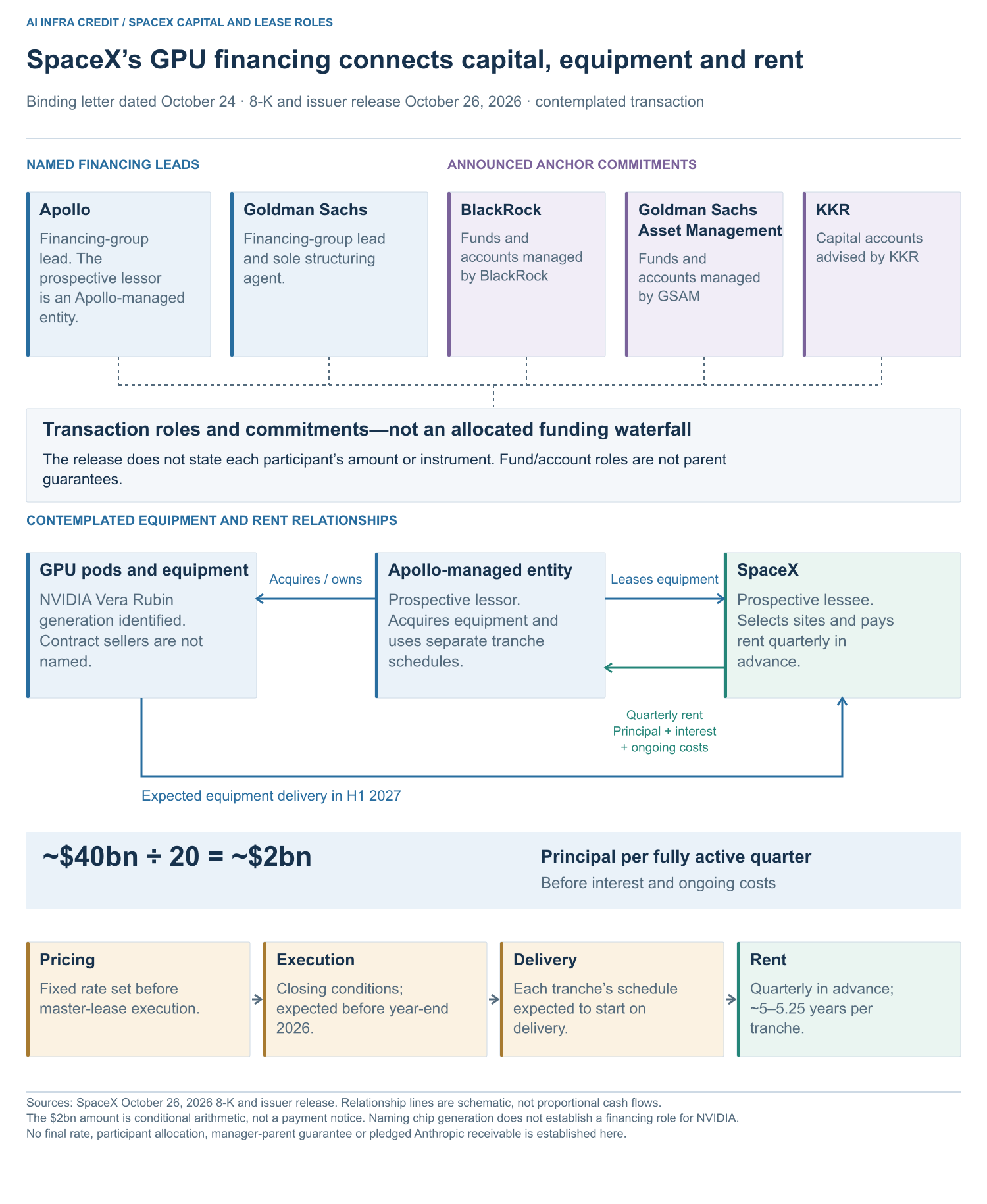
The financing changes the payment schedule
The binding commitment dated October 24 is to enter a master finance lease with an Apollo-managed entity. That lessor would acquire GPU pods and related equipment and lease them to SpaceX at selected data centers. Each equipment tranche would have its own schedule of approximately five to five and one-quarter years. Rent would be paid quarterly in advance, generally including one-twentieth of that tranche’s financed cost, fixed-rate interest on its outstanding balance, and certain ongoing costs and expenses. The rate is to be set before master-lease execution; entry remains subject to closing conditions and is expected before year-end. Individual schedules are expected to commence upon GPU delivery in the first half of 2027. SpaceX October 26 8-K
The October 26 issuer release adds a named capital network. Apollo and Goldman Sachs lead the financing group, with Goldman Sachs as sole structuring agent. Funds and accounts managed by BlackRock and by Goldman Sachs Asset Management, plus capital accounts advised by KKR, made anchor commitments. The release identifies NVIDIA Vera Rubin equipment, but not each contractual equipment seller. It does not allocate amounts or instruments among the capital providers. These roles should not be read as manager-parent guarantees. Issuer release
The approximately $40 billion is expected aggregate principal payments, not a demonstrated $40 billion cash receipt. The useful distinction is not a debate over the word “closed.” A signed commitment, final price, executed master lease, equipment delivery and operating compute each answer a different question.
For a financing analyst, the disclosed one-twentieth installment is immediately useful. If all $40 billion is active under that pattern, quarterly principal is about $2 billion. Interest declines as principal amortizes; the fixed principal installment does not. Equipment arriving later pushes a tranche’s payments later. It does not make the tranche cheaper merely by moving payments across calendar years.
Delivery timing can move billions between years
Consider three illustrations: all $40 billion starts at the beginning of Q1 2027; half starts in Q1 and half in Q2; or everything starts in Q2. With twenty regular quarterly installments per tranche, their 2027 principal payments are $8 billion, $7 billion and $6 billion, respectively.
At an assumed 8% annual rate, the corresponding 2027 principal-plus-interest payments are about $10.80–10.96 billion, $9.48–9.62 billion and $8.16–8.28 billion. These are payment scenarios, not forecasts of Apollo’s rate or SpaceX’s actual bill. Each range compares interest calculated on the opening balance with interest calculated after the scheduled principal payment. It is a calculation-convention range, not a confidence interval.

Open the full-size payment scenarios · Download calculated results
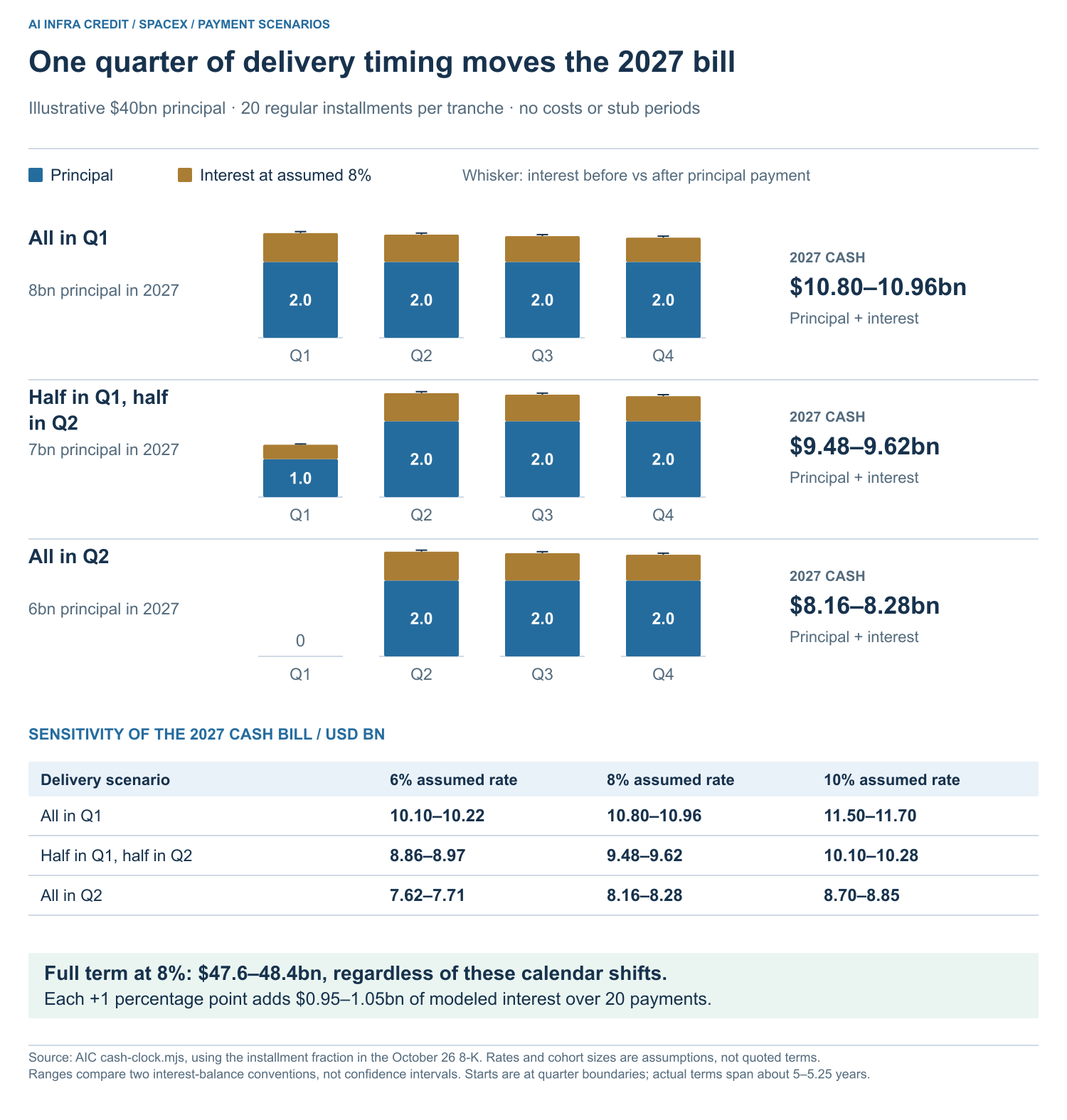
The same model gives two further conclusions:
- A one-percentage-point rate increase adds about $0.95–1.05 billion of interest over the twenty-payment life. Pricing therefore matters well beyond the first quarterly bill.
- Changing the commencement quarter does not change the modeled full-term nominal bill at the same rate. At 8%, all three calendars total $47.6–48.4 billion of principal and interest. Their first-year cash requirements differ, and so can their business economics: later delivery can also mean later revenue.
The illustration assumes quarter-boundary starts and twenty equal principal installments, beginning at commencement. Actual day-count, stub periods, the possible extra term within the disclosed five-to-five-and-one-quarter-year range, ongoing costs, taxes and early-exit mechanics are outside this calculation. Those details can change the final bill. The model isolates what the disclosed amortization pattern already tells us.
Historical funding puts the new lease in context
SpaceX’s January–September statements show $13.097 billion of operating cash and $48.069 billion of cash PP&E purchases, alongside $85.675 billion of net IPO proceeds. Cash, including restricted cash, increased $28.262 billion. The cash gap between operations and equipment purchases therefore was not a measure of new borrowing needed. September 30 10-Q, cash-flow statement

Open the full-size historical cash map
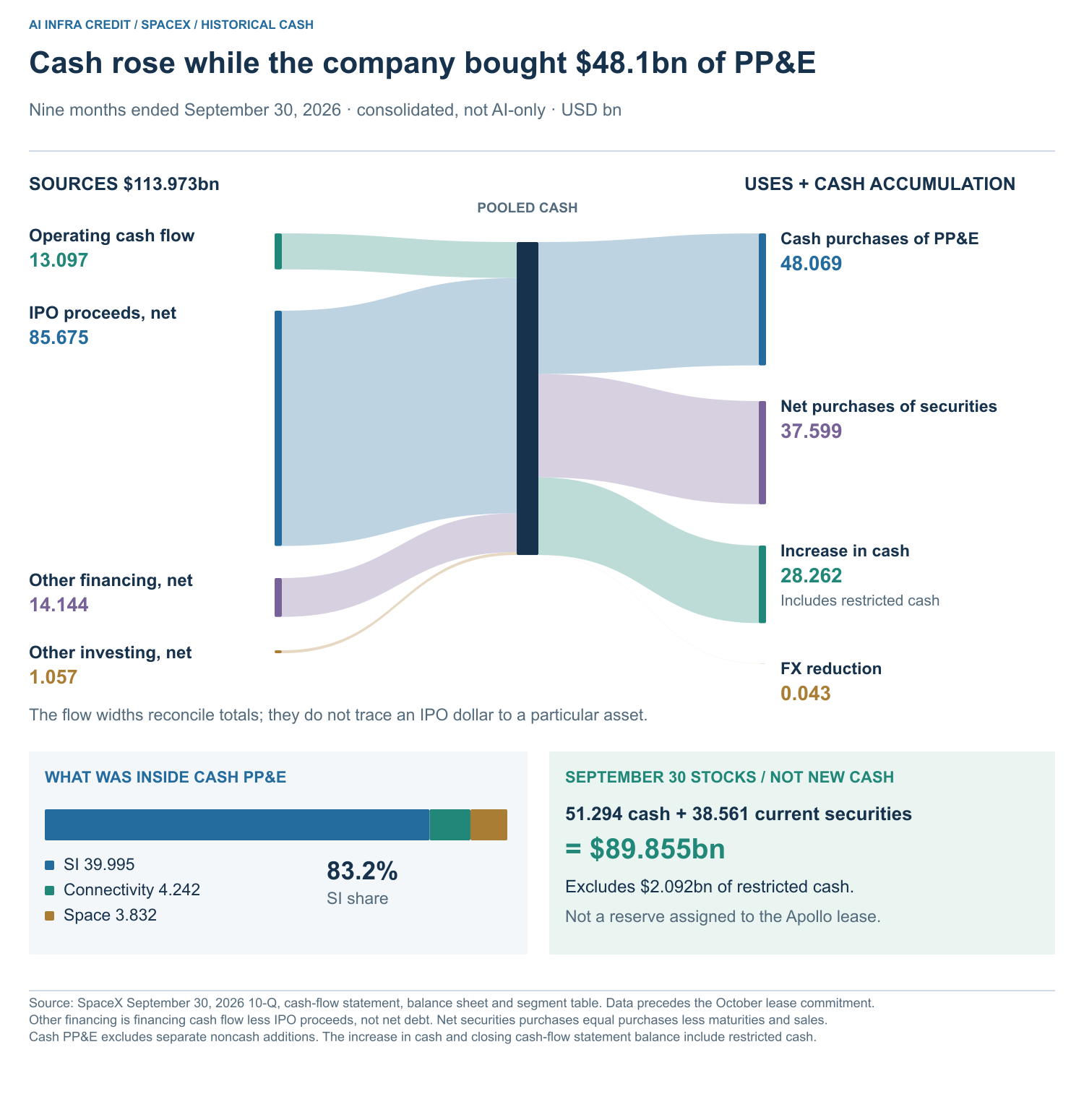
At September 30, cash and current marketable securities totaled $89.855 billion, excluding $2.092 billion of restricted cash. This predates the October commitment and is not a reserve assigned to the Apollo lease. The separate Valor arrangements were recorded as failed sale-leasebacks with related assets remaining in PP&E; they do not settle the future Apollo transaction’s accounting. 10-Q balance sheet and Note 17
The opportunity is to finance equipment without losing the cash calendar
This is a potentially productive financing design. A capital provider can own the equipment and finance its acquisition, while an operator concentrates on deployment and services. Separate delivery schedules can align financing payments more closely with equipment arrival than one upfront purchase would.
SpaceX's CFO also described sub-one-year payback on SI infrastructure investments. Fast capital recovery could support reinvestment, but the release does not define the capital base, cash-flow measure or relevant deployment cohort. The remark cannot establish this equipment pool's lease-payment coverage or be converted into more than $40 billion of annual cash generation. Issuer release, CFO commentary
But arrival is not the same as productive capacity, and productive capacity is not the same as collected cash. The critical interval is between the start of rent and the receipt of usable customer cash. That interval may be financed by liquidity already raised, other business cash flows or additional capital. It cannot be reconstructed simply by putting an unrelated customer contract beside the $40 billion headline.
Anthropic’s separately disclosed SpaceXAI compute agreement is relevant to the wider commercial relationship, but the October 26 SpaceX filing does not assign that agreement or its receivables to this equipment pool. We therefore do not draw a purported Anthropic-to-Apollo repayment waterfall. Related research on Anthropic’s payment and delivery conditions
For a researcher maintaining a cash model, the next useful update is a schedule, not a bigger headline: finalized principal, actual delivery cohorts, the agreed rate and interest base, and the first rent dates. Those facts would turn today’s principal run-rate calculation into a dated cash forecast. Evidence of commissioning and customer collections would then allow a separate assessment of coverage.
The constructive conclusion is that equipment financing can accelerate deployment by changing who pays upfront. Its durability depends on the payment calendar after delivery. For this contemplated structure, that calendar begins with roughly $2 billion of principal per fully active quarter, not with a one-time $40 billion cash inflow to the operator.
Data and calculation
The source register separates proposed lease terms, issuer-announced roles, historical statements and model assumptions. The standalone calculation reproduces the payment scenarios and cash identities; results are available without running code. The participant-map generator produces the updated structure diagram; the original figure generator retains the payment/cash charts and earlier 8-K-only map. See the package guide for scope and reproduction.
This issue uses the October 26 8-K and issuer release, and the September 30 statements filed October 22. The participant update does not change the payment assumptions or calculated results. Final terms or deliveries can change the cash schedule.